

Episode Description
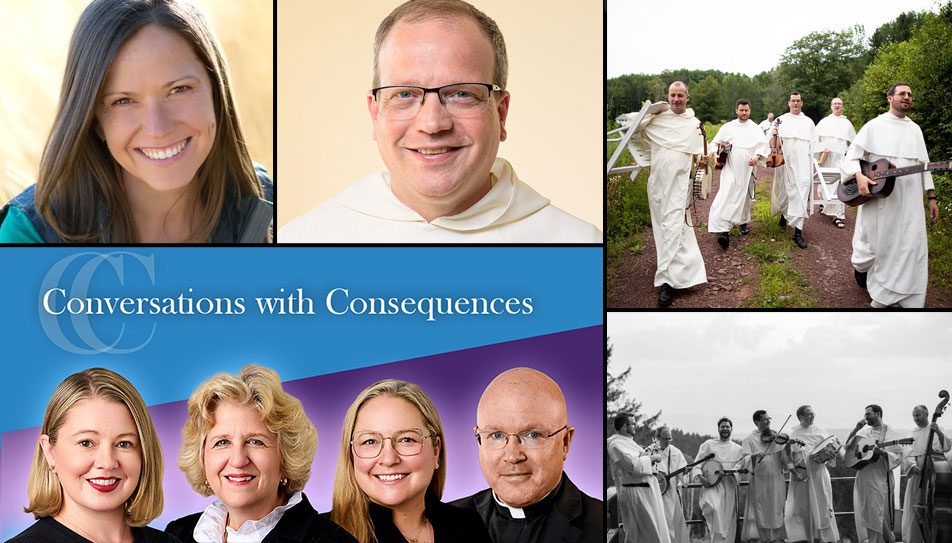
With the release of their latest album, Strange Land, Father Thomas Joseph White, founding member of The Hillbilly Thomists and rector of the Pontifical University of St. Thomas Aquinas in Rome, joins us to discuss how a group of Dominican friars turned a shared love of bluegrass into a powerful form of evangelization. From playful songs to moving reflections on mortality and divine providence, Father White shares the inspiration behind the band and the power of evangelizing through bluegrass and sacred music.

Annie Powell, co-founder of Camp Wojtyla, tells us why families should register early for the thriving JPII-inspired mountain adventure camp in Colorado that immerses young people in faith and creation, complete with outdoor Adoration. She discusses the powerful witness of priests and religious sisters who participate alongside campers, the vocations inspired by these experiences, and why families hoping to attend next summer should enter the camp’s registration lottery early.

In a culture increasingly saturated with disturbing headlines and graphic content, the TCA team reflects on Ashley McGuire’s latest Substack column, “The News Is Not an Excuse to Stare at Evil”. The team reflects on St. Augustine’s warnings about the spiritual dangers of dwelling on evil, the importance of guarding our hearts and minds, and how Catholics can thoughtfully engage with difficult subjects without becoming consumed by them, especially during Halloween season.

Catch the show every Saturday at 7amET/5pmET on EWTN radio!
And don’t forget to subscribe to TCA’s daily media roundup for smart Catholic news and commentary delivered straight to your inbox.
Bios

Father Thomas Joseph White, O.P., is a prominent American Catholic priest and theologian. He serves as the Rector Magnificus of the Pontifical University of St. Thomas (Angelicum) in Rome. Born in 1971, he is a member of the Dominican Order. He initially studied at Brown University, where he converted to Catholicism. He specializes in Trinitarian theology and Christology, as well as the relationship between grace and nature. He has authored many theological works and is known for his efforts to make Catholic theology accessible through the Thomistic Institute, which he helped found, bringing presentations to numerous college campuses. In addition to his academic pursuits, Father White is also a founding member of the bluegrass band, The Hillbilly Thomists, blending his love for music with his religious vocation. The group released their latest album, The Strange Land, in July, 2026.

Annie Powell is the Founder and Executive Director of Camp Wojtyla, a Catholic wilderness adventure program in Colorado’s Rocky Mountains. A former FOCUS missionary, she co-founded the camp with her husband, Scott, fulfilling a vision she felt called to pursue at age 15. Under her leadership, Camp Wojtyla serves middle- and high-school students through single gender sessions, combining high-adventure outdoor experiences with authentic Catholic formation. Campers experience the sacraments and the spirit of St. John Paul II, while guiding young people away from constant immersion with technology and into relationship with Jesus Christ and His Church. Annie holds a Bachelor’s degree from the University of Illinois and a Master’s degree in Adventure Education and Outdoor Programming from Prescott College, Arizona. She resides near Boulder, Colorado, with her husband and three children.

Ashley McGuire is a Senior Fellow with The Catholic Association and co-host of the nationally syndicated radio show, Conversations with Consequences. She is the author of Sex Scandal: The Drive to Abolish Male and Female. She writes for numerous news outlets and speaks regularly on major television networks, serving as a prominent voice for the pro-life movement and religious liberty. Her writing has appeared in The Wall Street Journal, The Washington Post, USA TODAY, TIME, Newsweek, First Things, RealClearPolitics, the New York Post, and The Huffington Post, among others, and she has appeared on CNN, Fox News, PBS, and most major television networks. Ashley has covered papal conclaves in Rome and testified in Geneva before the UN. She has spoken about the pro-life movement, religious liberty, and feminism in academic settings such as New York University, Princeton University, and Yale Law School. Ashley lives in the DC area with her husband and five children.
The following transcript is machine generated.
| Ashley | Welcome to conversations with consequences here on EWTN radio. I'm your host, Ashley McGuire. |
| Betsy | And I'm Betsy Fentress. |
| Ashley | And Dominican father Thomas Joseph White wears two hats. By day, he leads the Pontifical University of Saint Thomas Aquinas, otherwise known as the Angelicum in Rome, and by night he performs with the Hillbilly Thomas, the bluegrass band of Dominican friars whose first album climbed to the top of the Billboard Bluegrass Bluegrass charts. And now out with their new album Strange Land, have been touring across the country and we're delighted to have the one and only Father Thomas Joseph White with us today. Welcome to the show, father. |
| Father Thomas Joseph White | Thank you. Ashley, it's great to be with you. |
| Ashley | So give me a little history of how this band got started. |
| Father Thomas Joseph White | Well, you know, it was kind of a house band for kind of, I'd say serious hobby or a serious amusement of Dominican friars at the Dominican House of studies in like the area of 2014 to 2017, we used to play together not every weekend, but just now and then for fun. And then we made an album in 2017 because the the Dominicans at the House of studies had made a number of sacred music albums to sell and make money. This is back when people bought CDs, and then we thought we would make a CD of folk music and see if that could sell. And that strangely went on the Billboard charts. So that's how the band got going. |
| Betsy | So one of the things that jumped out at me was a song about Father Reginald Garage Lagrange. And how do you how do you do this mixture of this high academic stuff that you guys are teaching and then somehow magically blend it with bluegrass? |
| Father Thomas Joseph White | Yeah. So we have six albums now. One is those as a Christmas album, and we typically write our own songs. Not always, but we do. We do some covers, we write a lot of our own songs. And so what comes out? Our themes from within the Strange minds, Dominican priests and some of those are solemn, beautiful. I would say, you know, almost mournful, songs to God or about like, life in the Christian Pilgrimage. And then some of them are kind of strange. Funny, I would say playful songs. I think I write more of those crazy songs, so to speak. So in our on our latest album, Strange Land, which you mentioned, yeah, we have, we have a song dedicated to Gary Lagrange called Gary Goo, or it's about him and it's playful. And we started writing that when we were playing a concert here in Rome in the so-called Aula magna, which holds a thousand people, where we were playing a concert. He used to lecture there on Saturdays and fill that place on the first half of the 20th century. So we were sort of doing a sound check, and we started sort of crooning, with a something of a yodel, you know, Gary and, you know, kind of like that and sort of thinking what that would be to write a song about Gary Goo and, Anyway, I tinkered with it later and thought I if the more I added things about his philosophy, theology, and spiritual teaching that were slightly obscure references and including the fact that he was sometimes pugilistic, which that seemed to that needed to go in there too, a little bit playfully. And so when we came up with this mixture of like, references to his to mystic philosophy, theology and spiritual teaching and a really good bluegrass intricate like hoedown with a lot of, delicate solos from mandolin and fiddle. So it ended up being a really popular song. I think it's been the most popular song on the new album in streaming, so that's kind of bizarre. |
| Ashley | Your Christmas album came at a great time because it was the year I decided our family was going to get a little more strict about what we listened to during advent, and it was one of the few albums that made a cut. Made the cut because, well, it's a Christmas album. It also has a very advent vibe. It's a lot of kind of soulful, peaceful, calm songs, and my kids love that album so much that sometimes when they're deejaying the music in the car, they try to slip one in when I'm not listening. But that's a good one for for folks who are looking at advent coming down the road. But, in the US, we're always talking about work life balance. How do you balance running the Angelicum and recording albums and writing some of the music? |
| Father Thomas Joseph White | Well, you know, I do. I don't know. Much about brain science and right and left brain, but I do. I mean, there might be a lot to it, but what I do think is that when you go from kind of creative academic teaching and writing and certainly from academic administrator work over to song writing or song composition and working with people in music, you tap into a whole different person side, you tap into a whole different side of your personality and it's, it's restful, but it's not restful. Just like taking naps or, you know, catching up on your sleep, that it's restful, like in a really active and engaging way. So I, you know, I play a little bit. I have my instruments right here in Rome. I have banjo and a guitar right here with me, but I play every day. If I can find time, usually for like half an hour, sometimes longer. And in the summers, we all take a two weeks every summer to meet up and and record or tour. When we record, we have a retreat house in the Catskill Mountains in the north in New York, and we basically live the whole Aurora or schedule of the Dominican life. So we have morning mass. We have, you know, praying Lords and Vespers, the Psalms. We, you know, take turns, rotate in creating the meals and, undertake the whole life of religious observance. But there were during that time, our work is not external preaching or writing or teaching or, parochial ministry. Our work is creating music, and it's a totally different side of your personality, not in a not in a way that's like morally divisive or like intention or conflict, but just in the sense that you're tapping into a whole nother reservoir of how you express yourself. |
| Betsy | Have you found that there have been people that have been attracted to entering the Dominicans because they thought that they might have a chance of being part of this group? |
| Father Thomas Joseph White | Well, okay, so no, I haven't seen that so much. There are some there are some young Dominicans playing folk music or in general, a lot of Dominica do get engaged with music because part of our life. But I'll tell you what I have seen, which is that, first of all, as Ashley referred to, there's a lot of Catholic families throughout the United States listening to this music. Now, I think there's a lot of Protestant families to it's kind of expanding, and a lot of their children do get involved in music and like they bring their banjo or their guitar to the show and have you sign it. So they're like, clearly they're like trying to learn to play instruments. And I think it's making folk music or bluegrass music more a part of people's ordinary lives when they're driving their cars or when they're cleaning dishes in the kitchen, like the whole family is listening to it. It's kind of an ecumenical music for age groups. Parents like it and children like it. There's also a lot of college kids who listen to it. They've either grown up on it because they grew up in a Catholic family, and we've been publishing albums now almost ten years. So there's like people started when they're 14, they're now 24, and they've gone through all the albums. There's also a lot of young people thinking about a vocation to the religious life or the priesthood, who listen to it as kind of like their house music. So I think it's, I mean, I, I was, I was staying with the Nashville sisters in, in, Tennessee, you know, Nashville, Tennessee, the Saint Cecilia's sisters. And they asked me to, you know, just address the or talk to the novitiate, which is, you know, like 25 new sisters, young, all young, and like a lot of them had listened to the hillbilly Thomas in college. So I think it's kind of a background, I would say, kind of, metaphorically speaking, of background music to the spiritual lives of a lot of young people in America who are interested in all things Catholic, if that makes sense. Yeah. |
| Ashley | That's you mentioned people joining the Dominican Order. We have had a lot of Dominicans on the show, and it's very noticeable the way Dominicans are really engaged in new media, on social media, blogs, podcasts, and it's sort of not something you would necessarily think of for an order that centuries and centuries old. But can you talk a little bit about the sort of Dominican moment that seems to be happening culturally? |
| Father Thomas Joseph White | Let me talk about that in two moments. Why is it happening culturally, and why, like engagement with media is not entirely strange. So maybe I'll start with the second thing. Like when Saint Dominic 800 years ago founded the order, he didn't found institutions, you know. So we don't usually run universities, our own colleges, although occasionally we do like the one here in Rome that I'm working at. But typically we we our priority is our next door to universities. Right. So that's historically we founded at the Sorbonne and, and the University of Paris or in Oxford or Bologna and whatnot. And so in a way where parent institutional, we find existing institutions and we preach alongside or we engage academically in those institutions. So right now we're in a hugely interesting moment where, okay, there's things about the media and artificial intelligence, but we also have this pair institutional format where we can go anywhere. So you can present Christian ideas at a very high level, high levels of philosophy and theology or more popular catechetical level, or just like engage with people online and you can basically you're able to preach and teach everywhere. So in that sense, I think it's like a reinvention of a medieval charism. That's not that strange. It's, you know, if your thing is preaching and teaching people everywhere, the internet's a natural place to do that. Regarding the Dominican moment, I think there is something happening for sure. In the English speaking world. It's not just the United States, it's all four provinces of the United States, but it's also England and Ireland. And there's some other places where you're seeing rebirth and growth. And I think it has to do with two things. The first is in a more intellectually confusing or confused and contested era where people are debating a lot of things political, philosophical, ethical, theological, where you have a lot of new non-religious people, but you have a lot of new non-religious seekers becoming interested in becoming religious. And you've got kind of a lot of Christian apologetics and Islamic apologetics. Our charism is about clearly studying, thoroughly understanding and teaching Christian thought and taking seriously the objections of others, understanding other philosophies, other religions respectfully, and trying to engage in an intellectually clear minded, truthful, charitable way so that you could call it doctrinal slash intellectual vocation is really applicable right now when people are like looking for a clear understanding of what the Catholic Church teaches in engagement with a whole lot of contested ideas. And the second thing is, our life's really visible as a moniker of Catholic identity, because where the habit we have, we don't just pray alone, we pray in liturgical priories where we have more ornate liturgies, we put effort into the beauty of liturgical, traditional, liturgical music. I'm not talking about Hillbilly Thomas. I'm talking about like a green chant and like irreverent liturgy. And so a lot of young people are looking for like a tangible sign of the sacred in the liturgy, more liturgical solemnity. And they want to witness to their colleagues that like, hey, you know, Christianity is a thing. So I think the order, by its visibility and its commitment to public liturgy and public preaching and teaching and clarity of expression, it has been attracting a lot of people. And we're definitely seeing that not just vocations, but also people becoming Catholic or entering Osseo at Dominican parishes, which the numbers are quite, you know, elevated, which is very encouraging. |
| Betsy | Whether your bandmate father Austin Litke observed that traditional American folk and bluegrass haven't historically been predominantly Catholic, but you guys are making your music to sort of infuse what's probably a more Protestant stronghold. You know, Kentucky, Alabama, Georgia, Tennessee. Yeah, kind of. |
| Father Thomas Joseph White | Say I would. Say actually, Kentucky, Tennessee and North Carolina is where you find old time and bluegrass music and and Alabama, Mississippi and Georgia are we find blues. And so we actually trade a little bit in both. But to, to you know, look, I mean on the one side you have this old time music, old time and bluegrass music, which is filled with religious longing, overt religious confession, very Christ centered, at times sometimes humorous about human foibles and weaknesses. And we are, you might say, culturally appropriating that as Catholic priests because, well, a lot of us are Southerners. He's from Kentucky, by the way. I'm from Georgia. And when you represent that from within the Catholic tradition, it's like, oh, you know what? There was something going on good there. And we're going to represent it from within a kind of like Catholic world. But we're it's something old America. But the other thing that happened after that is what what happened after bluegrass and old time music was you got a country like, I'm talking about Hank Williams, and then you get that Johnny Cash, and then eventually Bob Dylan and the folk music, movement. That's confessional, confessional poetry. So it's not as religious, although in someone like Johnny Cash you get both, but eventually you get modern confessional poetry. And then, of course, it's interesting. Dylan moved over into confessional Christian belief at some points. So if you put those two things together and then you Catholicism, you've got the old religious music, then you've got the kind of confessional folk music, poetry stuff that comes out and gives you the early strata of country and folk. And if you, you can kind of absorb all that within a Catholic framework because you can talk about the soul, you can talk about the humor and the grace of the human being. You know, assaulted by the mercy of God, inspired by Flannery O'Connor. As we are, you can talk about, the the morning and melancholy of this life. You can also celebrate the designs of God's grace. And you can also talk about the human human suffering, human longing, human loneliness. You've got a lot of stuff in there to work with. |
| Betsy | Because this album has like the song that you wrote about Elvis, the good old Elvis. He died, good old Elvis, he died. And then you say, I don't. You're the you're the singer on this song. I Don't feel so good myself. Is that song out of a particular tradition or or artist? |
| Father Thomas Joseph White | Oh, well, that's. Totally an image to Ralph Stanley. Oh, that. Oh death. And it's like the it's the old time kind of bluegrass standard where we're we're all going to die. But like, let's think about this in light of the promise of eternal life in Christ. So good old Elvis, he died. He shook with glory as he danced in the light. But good old Elvis, he still died. I don't feel so well myself. Lord, won't you come down and give me some help? Because I don't feel so good myself. That's an homage, by the way, to Lewis Grizzard, who wrote a book. A similar title back in, is an Atlanta journalist back in the 90s or 80. Elvis is dead, and I don't feel so good myself, so it's obviously humorous, but it's also, you know, the song goes on to say, every man and every woman is a sinner, but you can be given and become a new beginner. And, you know, they nailed him to an old cross of wood. Man did evil, but God brought forth good. The tomb was empty after three days, and I'm still crying. But now I can pray. Every man and woman lift your hands. Every man and woman lift up your hands. Praise the Lord Jesus till you finally understand. So there's a there's a sort of resolution that's solemn, even despite the kind of humorous entry. And of course, it's Old South because, you know, if even Elvis can die, I guess we all can die. So, you know, it's a it's a kind of mortality tale, playful and in serious. |
| Ashley | Talk about the album title, it, you know, made me think of Just Strangers in a Strange Land, the kind of Christian. |
| Father Thomas Joseph White | It's a direct it's a. It's a direct reference to that line of scripture. And a lot of our albums are really about pilgrimage. You know, we are a little bit alienated or we're a little bit strangers in a strange land, but we're also homeward Bound. So there's a lot about the celebration of the pilgrim state. You know, we're going somewhere and there is joy in the pilgrim state. I mean, I actually often say to the brothers, when we're recording, who are very good at ignoring a lot of my enthusiasms or my little whimsical ideas. Rightly so. I say, you know, we got to think about what this is going to sound like in the car, because the families are listening to this in the car and they're like, yeah, Thomas, Joseph, we heard you about the car, but, you know, in the car we are on pilgrimage. The Catholic family is the Catholic couple, the Catholic single person driving somewhere, the Catholic priest driving somewhere. We're we're going somewhere. We're on pilgrimage. It is also a very big theme in Flannery O'Connor books. You know, the car is kind of a sign of the autonomy of the person trying to make their way through this world, and often right before they get converted, their car breaks down and their cars interrupted cars, an American sign of being going somewhere, being on pilgrimage, or maybe being going the wrong direction or the right direction. So, you know, we have a song, Old Highway, which is about sort of appropriating a Chevrolet. It's not clear if it was stolen or not in the song. And just driving West with God's grace, you know, just going on in a providential adventure and trying to find God out west on highway 66. So, you know, it's like kind of there's a lot of pilgrim imagery, slightly, I would say unfocused, sometimes very intentional, sometimes kind of in the background. |
| Betsy | Can you talk about the song Providence Waltz and some of the because you have a school in Providence, but some of the inspiration for that, because it seems very local. |
| Father Thomas Joseph White | Yeah, it's a beautiful song. Justin Bolger wrote that gorgeous song, which I think is worth listening to over and over, and he has been chaplain at Providence College and and now he's the chaplain at Brown University on the east side of Providence. So he's been chaplain in both places. And she spent a lot of time, years and years in Providence. So a lot of the Puritan street names like Hope Street or Benefit Street, you know, they have these kind of, I guess, biblically inspired names. And he basically writes a song. It's confusing if you're if you're not, if you're not clued in and it's sort of in a way, I think good. And it's sneaky, but it basically the idea of I'm waltzing with this partner through these streets, who am I waltzing with? What's God? Right. And always I'm always getting behind in the waltz, you know? But what he's talking about is cooperation with divine providence as a priest working for God in Providence, Rhode Island, dancing, as it were, with God through the streets to try to help people and trying to keep up in time with whatever God is asking us to do. But it's really he's not just about being a priest. He's inviting us to think about, like, through this world, being in providential harmony with God or providential rhythm with God. So it's a really profound song, but it's a waltz and it's super beautiful, a lovely, lovely music and and deep, deep words. |
| Betsy | Do you, when you guys sit down? Do you have an idea of each person kind of wants to be in charge of one of the songs or be the main writer, or is it is it really super? |
| Father Thomas Joseph White | Or you write the people. Different people write songs. I think there's like six people written songs. I mean, so but you know, I've written some, Justin's written some, and there's others and Peter Gauchos writing a lot of songs. So what we do is we you take the song concept, which is usually shared by a, you know, virtually because somebody records it and shares it with a band. And then when we're actually recording, we sit down for a few hours and we work with the song until we come to a common mind about what to do with it. And the songs often changed quite a lot. I don't mean so much the melodies or the words. Sometimes the words might change, but like maybe who sings a song or how the harmonies are arranged, but certainly all the the wider setting. What instruments are privileged, how the what you might do for, soloing because, you know, you record some of that stuff in, at, at, you know, leveling you sort of recorded in afterward. So you have to kind of get a base, a standard base recording that's going to be your core. And you might do 15 versions of that or maybe ten versions. So you have something that really works, and then then you're going to record over, you know, in addition to that, your solos. But you got to think about and then you try. We try. To do a lot live. We try to do a lot with the harmonies in actual time, with a fair amount of the instruments in actual time. So it has a live feel. It's a little less pristine feeling, a little less studio produced feeling. But we have a studio and we have a sound engineer, and we love working with the the professional sound engineer we have. And so there's a kind of deep creativity and actually a huge amount of collective engagement there because we all work together on what we think the sounds should be like. And of course, that there's a set in that, but there's also something greater comes together than anything any one person could produce on their own. |
| Ashley | Speaking of Strange Land, you're an American living in Rome with the first American pope, and you also lived in France. What are your kind of initial reactions to having an American pope? What that's meant for the church, and also your observations of the Pope's extraordinary trip to France. |
| Father Thomas Joseph White | Well, you know, I always say. That the first thing to say is I know about as much about the Pope's agenda or what's going on as anyone who observes in the media, because I have basically the same access as everybody else, although, I mean, occasionally I find out little things that are interesting in Rome, but not any great intrigues or like, super gossip. I mean, I basically watch the pontificate unfold in real time like everybody else. |
| Ashley | But you didn't get to give them your album. |
| Father Thomas Joseph White | Yeah, yeah, I bet him. Yes, we've talked and I've given him album and I'm very honored that he took them for me. The, the. Yeah. So, I mean, I also give him some books of theology I've written, but I don't know if those got anywhere, so, so, look, I think the pope, he's an American, but he's also a canon lawyer. Incidentally, he studied here at the Angelicum for his doctorate in the 1980s, and he is been a major superior of a religious order where they work through communitarian processes. A lot of, you know, open discussion and then final decisions being made. So I think he's used to process of consultation, respect of the voice of different, you know, persons tolerating or accepting that people have, you know, term limits. And like they, they rotate through and you respect their office. So I mean, I see him governing the church very much like an Augustinian superior who's a canon lawyer, who is working with the with the group of people that he came up through the system with. And he's just like an Augustinian superior, kind of working with the prior provincials, with the priors. And, you know, everyone's got to do their job. And as people, as a terms expire, you put new people in, but you always try to find competent people. And I think he's succeeded in creating a very good sense of listening, of a, of a kind of reasonable centrist discourse of theology and spiritual life, of a celebration of liturgy that people can agree is is sober and beautiful and of a kind of a sense of peace and calm in the church. Besides that, I think he has a missionary verve from his time in Peru, and he's now taking that into Spain. He's saying that into, France. And he's, I think, intending to do this just similar kind of thing in Argentina very soon, as well as Uruguay, which Americans might not know is a strongly secularized country. And he's gonna spend a week in Peru. He's got some other things he's doing down there, I think maybe Chile. But in any case, the Pope is, engaging with secular opposition constructively but clearly. And he is evangelizing young people. And what you're seeing is there's a kind of a about his pontificate from young people who I think feel like there's an air of stability, an air of, calm Christian identity. So I think what's happened recently in Spain and in France, with like a million people coming to mass, or maybe just short of that in both Barcelona and Paris, that's a huge a positive turn. And I do think it's indicative of people becoming Catholic in those countries or returning to being Catholic. And I think it's going to also, we're going to see some vocation uptick. And he's reaching Europeans. So that's nice. I mean, that is you that the the office of the papacy is beyond nationalism, that, you know, basic I mean, my priory's French here joked with me that he was in France just after the Pope was elected. And he said, it's a miracle. I'm seeing thousands of young French people enthusiastic about American leadership. And, I mean, he was joking. Of course, but he's he's he's he's joking. But it's true. You know, there's a great spiritual love of the pope and belief in the importance of the papacy and Leo's sense of calm and deliberateness and his unpretentious kind of evangelization is is charming to a lot of young people in Europe. |
| Ashley | Well, father, were just out of time. But tell us where people can find this latest album and where they can find all your other music. |
| Father Thomas Joseph White | Well, the Hillbilly Thomas are there. Music is available anywhere live in streaming music is available. So in other words, you can find it at our website, hillbilly thomas.com. You can find it Amazon Music, Spotify, Apple Music. Just just search hillbilly. You can also put all of it on YouTube. So, you know, it's it's easily available through a simple internet search and I hope you enjoy it. |
| Ashley | Wonderful. Thank you so much for joining us today. Father Thomas Joseph White. |
| Father Thomas Joseph White | Great to be. With you. |
| Ashley | Welcome to conversations with consequences here on radio. I'm your host, Ashley McGuire. And although we are well into fall and actually approaching advent, it is summer camp signup season for many camps, especially popular ones like the one we're about to talk about, and one of the many wonderful camps that every Catholic family should know about is camp boy Tiwa in Colorado, my home state. And we're delighted to have the co-founder of the camp, Annie Powell, with us today. Welcome to the show, Annie. Thanks, Ashley. |
| Annie Powell | It's a pleasure to be here. |
| Ashley | So full disclosure, my daughter has gone to the camp for several years in a row and is planning to go again next summer and has absolutely loved it. And one of the things I'm struck by as a mom of five kids who's had kids in many, many camps is that this camp is so much more than a summer camp. And so, Annie, you founded in 2007 after serving as a focus missionary and working in camp ministry across the country. So looking back on Curtis Martin's early encouragement, how has the camp's vision grown or evolved over these past couple of decades in the Rockies? |
| Annie Powell | Oh, it's a great question. Well, when we started, we had 48 kids and a six day program just to test it out. Like, do kids even want to do this? Do they want to get off video games? This was before even the iPhone came out. And and I would say what's really interesting is there's been a really healthy evolution to match where kids are at. But so much of the core of the program is exactly the same. And so our goal was to take kids out into the wilderness, into a place where they could encounter the Lord in the silence. Even though the wilderness isn't very silent, it has a different quiet than our daily world, I would say. And in that silence encounter the Lord. They hear his voice, and then they do things that are beyond what they normally do and beyond what they think they can do often. And they challenge themselves, whether it's in rock climbing or hiking or whitewater rafting, sleeping in a teepee, whatever it is, they're doing things beyond what they thought they could do. And there's that, that stretch, that, that growth that happens. And so all of those things that we started with, because we started with a lot of intention, I would say in a lot of research, I got my master's degree and, you know, did a lot of work to to create the program, but it's just gotten bigger and I would say better. And so we try to refine it to be the best program it can possibly be in every area. And I think that's what that's what has changed over these 20 years. |
| Ashley | One of the things the camp does is post pictures. And so for parents who don't, you know, I'm in the D.C. area, so we stick our daughter on a plane and we just kind of experience it through the photos. But the the beauty really exceeds expectations, even for somebody who grew up in Colorado. And you've said that God speaks to young people through a raw, beautiful encounter with his creation. Can you talk a bit about how people how these campers deepen their faith in and encounter with beauty in nature? |
| Annie Powell | Well, John Paul the Second, our wonderful patron. So Saint John Paul II, I should say he had this wonderful quote. It was in his World Day of Peace address, and he said that our very contact with nature has a deep restorative power. And I think science has proved that what it does to our brain, our body, our nervous system. But I think beauty speaks a very deep language. So nature really does have a deep restorative power, whether it's in our nervous system or how we even see ourselves. When the kids look out and they say, wow, God, you made everything so beautiful. And we say, and he made you even more so beautiful. Creation was was good. Humanity was very good. And so when when they realized that and they realized that God makes beautiful things and he made them in his image and likeness, there's a power to that. There's a real power to that. And I would also say that the peace that young people feel in the beauty of creation is where they can hear his voice, whether it's up at adoration in the morning when we're up in our little forested area where we have adoration, or if it's on a hike and they're just overlooking a mountain vista, it's so much easier to hear the voice of God in these environments and in that beauty, than it is in the hustle and bustle of the world, with our notifications pinging left and right and and really the visual assaults that are happening daily for these kids. So the beauty and the quiet are very, very powerful. |
| Ashley | Yeah. Talk about the tech thing, because I'm sure the camp self-select for kids who are probably living a lower tech life than than the average kid. But even so, I mean, you know, my kids don't have phones, but the stimulation is really incredible. The kids have to deal with. And and not just that, but you also mentioned, like, the hustle and bustle and, you know, there's no question kids are overscheduled today. So do you find, especially with your older kids who, you know, may have phones, that that is kind of a struggle. Like, do they go through withdrawal or how has that evolved over the years to with with the changing? You know, you mentioned first it was video games. There wasn't even phones. And now we've got phones and, you know, dumb watches, smartwatches. So how have you managed that challenge with, this latest generation? |
| Annie Powell | I would say kids used to go through a bit of a withdrawal. Now it's interesting. I'm seeing more and more that the kids, they actually hate it. |
| Ashley | They actually. |
| Annie Powell | They they love their phones. They want their phones. They hate their phones. And they hate what it does to their friendships. They hate what it does to society. And when they come, a lot of them are like, take it. I don't want this thing. And it's not like they want their parents to take their phones away because they do want to connect with their peers. And and we haven't. There's not a lot of alternatives for them at this exact moment. Right. We're trying to do that. You're trying to do that as a parent. I'm trying to do that as a parent. But what's happening is they they're like, please, like take this phone and I'll ask them at the end. I'm like, okay, so what was it? I know you didn't want your phone, but you don't want your mom to take your phone away back home. So like, what's the difference? And they say it's because here nobody has a phone. And here we're all connected. It's not like I'm on the outside because I don't have a phone and everyone else is like inside this group of knowing and connection. And so for them all connected over things that have nothing to do with the phone, have nothing to do with social media or even pop culture is something we say, hey guys, like, yes, you might half of you might know that reference, but half of you might not. So let's just have our own culture here. Let's not bring pop culture into this, because that's not our shared community and our shared experience. And so then they have their shared experience of going on High Line together. They have their shared experience of climbing a 13,000ft mountain together. They have a shared experience of whitewater rafting down the Colorado, beautiful, you know, Browns Canyon, that amazing stretch of river on the Arkansas River. That's amazing. And these are experiences they can talk about, relate about, and just have an incredible, common experience to then laugh about, joke about, connect on. Wow, that was really intense. That was really, whatever. Like it's just something that's real. And that's another thing is what we talk to the kids on the last day, we say, okay, someone's going to say to you now you're going back to the real world. And we'd like to propose that that's actually not true, that right now is the most real it's going to get when it's raining. We feel it when it's beating down sun. We are very aware we are in it. We are very much in the real world. You have an emotion. You have people there to receive it. This is a very real world here. When you go back home, it might be your regular world, it might be the routine that you're in. But it doesn't necessarily mean that's the real world. |
| Ashley | That's fascinating because it's almost like they get, I don't want to say simulated because it's real, as you just said, but like a taste of what? Of how people lived for so long, which was in small, close knit communities where you probably saw a lot of each other a lot, maybe at times more than you'd like, but. Right. Yeah. That interconnected, experience. So that's interesting. Well, one of the things that's I think so unique about the camp is the way that you have, religious priests and nuns who are integrated with the campers. And, you know, you'll see pictures of, you know, nuns and habits, rappelling, rafting with the girls. Talk about that. And you know, how that came to be and how that impacts the kids. And I know the camp also has produced quite a few vocations over the years. |
| Annie Powell | Right. No, that is very true. Well, back in 2013. So, you know, we were we've been doing it for a few years, but not many. So back in 2013, I was at a women's conference. And I was at this like leadership Day. And there was a foundress of an order there. And she had this amazing accent, and she looked at me and she said, Annie, you have been talking about camp for Tiwa, and you've been talking about your seminarians and your married couples and your priests. But I don't hear anything about the sisters. And I was like, well, we don't have sisters. I don't even know how to get sisters. And she said, well, I can help you with that. But without sisters, hun, you are limping. And I was like, yes. And she was so right. She was 100% right. So she helped me understand how I could connect with orders, how we could invite them out and get them to come for the various weeks to come for staff training and sisters change everything, their joy. They're just complete reliance on God. That witness is so beautiful and so they come rock climbing with us. They go whitewater rafting with us. They are doing all the things that the kids are doing. They're sitting down doing crafts with them, and it's so healthy because for the guys, we don't have them at guys weeks. We want them that guys weeks, but there's only so many sisters to go around and we can't we can't get them for our guys weeks at this current moment. But when we have them with the girls weeks, the girls are able just to have very normal conversations with the sisters to see that sisters are real people. Sisters at one time were 13 years old, just like them, making the decisions that they're making to have a prayer life and to rely on God. And so it's incredibly relatable, and it makes the idea of vocation a lot less scary, especially when they share their vocation story. And they say, I didn't know what I was called to at 13, but I knew I loved the Lord, and I knew I was called to pray. And then when their vocation called, their vocational call came. It came like with joy and peace. So that makes it less scary for the kids to know that when God calls you, it's with joy and it's with peace, and it's not this big dramatic thing so that the presence, the walking with them, I think has had a huge impact on the vocations that come out of camp. And I would also say the the prayer life that we teach kids how to have at camp is also a big part of that. So when I had two girls who had just recently joined orders and they said both of them separate of each other, said, I heard my vocational call at Camp Tiwa when I first started to pray because I hadn't prayed before, I didn't know how to pray. And when you taught us how to pray and we had this time in adoration, I heard God's call for this very unique, distinct life that I was supposed to have with him. And and again, there's nothing ultra specific about Kampuchea in this. We're just trying to set the table in a way that the kids, when they come, they can hear the voice of the Lord and they can, really learn how to reflect on their own experiences, too. So that's another thing is when we do these activities, we don't just do them to have, like a fun day, rock climbing and then talk about Jesus at night and put prayer in the middle of that. What we do is we actually, you know, we always start our day with prayer and we live sacramentally. So we have daily mass and we have confession, but we also teach about the Lord through adventure. So when we're rock climbing, we're talking about what it is to trust. What is it to trust God? When you get to the top of a climb, you might get to the top of a climb all by yourself. Easy peasy. You just did it. You're like, you know, you're tough. You can do things on your own. But then when it comes time for getting lowered, you can't do that on your own. You'd be going 70ft down all by yourself, and that doesn't have a good end. So you have a bully or someone who's slowly lowering you down, and you have to trust. You have to trust them because you have to let go of the rock at some point. And it's really funny moment where you say, okay, you got me. Are you sure you've got me? Let go. And then that's that moment. We're like, oh, that's what it means to surrender. That's what it means to trust. It's completely letting go and letting the Lord guide and letting the Lord take care of you. And that's what it is to trust one another. And so it's this wonderful. Like we can say things like we trust, but when kids experience trust, then they can understand a little bit more how to apply that to their faith and into their lives. And so everything at camp is meant to be integrated so that everything is a lesson. Everything is a moment for God to speak to you and for them to learn how God is speaking through everyday experiences. He might speak to you in adoration, but he also might speak to you in the hallways of your high school. And he likely is. So we're trying to like, teach them how to have the ears to hear how the Lord is speaking to them every moment of every day. |
| Ashley | I recently read a quote from one of your middle school campers who was doing archery, and he said, if you don't for heaven, you won't get there. That something about pointing the arrow at the sky clicked for him. Well, I want to make sure we leave time to talk about, you know, how people can sign up and find out more. But can you talk briefly about a little bit more about your patron, Carol, and how his legacy shapes the mission of the camp? |
| Annie Powell | So as father Carol voice, he he would take young people into the wilderness. And this was at a time where it was illegal to be like we're talking, you know, all that Poland went through with the Nazis and then the communists. And at this time it was illegal to be Christian. I mean, he had to go in the underground seminary in order to become a priest. So when he's teaching these young people in the wilderness, it's not just to be in the wilderness. It's also like it's very, strategic to get out of communist controlled areas. But it's also he understood. I mean, his writings were so clear about the power of nature in our lives, the power of like that quote shared about restoration, that nature has a deep restorative power. And he he really believed in young people. He really believed that the capacity for holiness at a young age was possible. It's not something you like become old and then you become holy. Like he knew that everybody and in his universal call to holiness, the church is universal, called holiness. But he really emphasized that, that we're called to be holy as a teenager. We're called to be holy as a engaged couple, married couple, priest, sister. It doesn't matter. God has a path for each of us, and each of us has a path to holiness in that, in that call. And so he was so prayerful and he was so strong against very controlling forces. And one of our favorite quotes that we start most camps with, actually, is when he came back to Poland for the first time after becoming pope, where he says to them, you are not who they say you are. Let me remind you of who you are. And that's really powerful to our young people today. Let me remind you of who you are. You are not what social media says. You are, not what society says about you. You. You are created in the image and likeness of God. You have a beautiful call. You are beloved. You are not, You are not your weaknesses. You are the sum of the father's love for you, right? Like it is. He had so much knowledge and wisdom and even his theology of the body. Just so much of what we do is experience. It's how God is, you know, it's really living out the gift of who we are, the gift of our authentic femininity, the gift of our authentic masculinity, and not being confined to stereotypes. I always tell the young people you are, you are masculine because God made you male. You are feminine because God made you female. Nothing you can say or do will make you less masculine or less feminine. And in fact, just to be proud of who God made you to be. And I said I can. I can drive my husband's jeep and get all muddy. And that's actually feminine by nature of me doing it. And but when we talk to the guys about their authentic masculinity that it can't be arnd it's not meant to be something that they have to become. It is the gift of who they are. And so we really try to live out JP twos writings. Saint John Paul the Second is not just a hero of ours, but he's a mentor and remains a mentor today in his writings. |
| Ashley | Well is unique in that you you're so popular that you operate with a lottery system. So can you talk about the lottery system? I know we're in that right now, and how people who are interested can find out more and sign their kids up. |
| Annie Powell | Yeah, absolutely. So we used to just have, you know, we start registration at 9:00, and then when we fill up, we fill up. But the problem is we started to fill up in like three minutes. And people like, you know, office has had firewalls. We had a lot of families in DC. They like they couldn't get their kids registered in that three minutes. And so just to make it a little bit more, make it a more fair, we open the window up and you could in a whole, you know, ten day period of time, we try to have a full week and two weekends where you can come in and you can just register your kid for this lottery. And then we do a drawing at the end of it, and that is how you will get put into your your week for the summer. And we take preferences. So we try to get you into the week that you want. We try to get you in with a friend. It's like a very complicated system, but it works. And all a parent has to worry about is signing up for the lottery. It takes five minutes. It's free, there's no money down, and you can just see. And then if you're on the waitlist and you never get off the waitlist, we do work through the waitlist quite a bit after initial spots are, are, are taken. And then people say, oh, I forgot about the trip to grandma's, or I forgot about this. And then they release those spots. And so we do work a lot through that waitlist. But if you never get off the waitlist, then you actually have the chance to register early for the next year. So we try to make it so there's a preference for all of those people who had to wait, and then they get their first pick of the week they want for the next summer. |
| Ashley | Great. Well, to learn more about Annie Powell and Camp Tiwa, please visit camp w.com. Annie, thank you so much for joining and wishing you a wonderful next camp season. |
| Annie Powell | Thank you. God bless you. |
| Ashley | Thank you. |
| Betsy | Welcome back to conversations with consequences, where I am with my co-host Ashley Maguire, talking about her latest Substack, which is getting some traction called The news, is not an excuse to stare at evil. Ashley, what was the impetus for you writing this? Where you link various news items that seem to be pulling people in to the darkest side of human nature? |
| Ashley | So really, it was the Cornell seven case coming on the heels of the Lindsay Clancy case, and it just started to feel like the news was a little bit overly saturated with this stuff. And it wasn't just like, oh, here's a news article. It's just like a steady drip or a steady stream. And a lot of it, is really titillating stuff, you know, stuff we don't necessarily need to see. And, you know, I'll admit that I followed more towards the end the story of the Lindsay Clancy case and found myself having to kind of put a stop to it because it was disturbing. I don't think it's a natural thing, for moms or really anyone, to be spending a lot of time looking at and thinking about a story of a woman who killed her kids. It's it's a tragic story. And, you know, one of the points I'm making, the Substack is I don't think people were spending so much time on that case because they cared about, you know, the laws in Massachusetts about legal insanity. They were looking at it because it was it was morbid. And it's a human condition that we have, which is, you know, there's an accident on the road and you slow down because you want to look, it's it's part of our human nature. And I think there's something to that with this Cornell case. And in the post, I just straight up say I won't read the stories. You know, I opened one and I was like, I don't need this. It's it's kind of pornographic. I'm sorry, but it's it's the details are salacious and it's not a thought that I need in my mind. And this is something I've gotten hopefully better at over the years, is learning to protect myself, my mind, what I watch, what I look at, what I listen to. And in the Substack, I, I quote Saint Augustine, who, you know, wrote about this centuries upon centuries ago. And I think, actually, that the Catholic Church has a lot of wisdom to offer here, which is, you know, the Catholic Church understands human nature so well and has such a well rooted and well formulated, wisdom has that wisdom to offer to people. And, you know, he, he calls it curiosity us and it's not necessarily good for us. And I don't know, Betsy, I don't know you and I have talked about this, but one of the other things I get into is the thankfully proposed called off public execution. But what were your, you know, initial reactions that it was shocking. |
| Betsy | I was really horrified. And another colleague of ours talked about in the medieval ages that the executioner, was often given a stipend by the person who he was executing, that there was all this ritual, you know, not to mention people's heads were covered. And, and not that I'm proposing that I think that was a good thing, but it it seems particularly barbaric. I mean, that's the word that kept coming up over and over. And you said that in the official statement that you wrote for the Catholic Association. I just think it is such a coarsening of our culture and the cheapening of life. And I don't think live streaming an execution has anything to do with the public sense of justice being carried out in, in some honorable way. And I wanted to go back to what you said about Saint Augustine, because the quote that you wrote was, for what pleasure is there to see in a lacerated corpse, that which makes you shudder? And yet if it lie near, we flock there to be made sad and to turn pale. Just what you were saying about slowing down for the accident, I just don't I don't think it's good for our sense of the value of human life. |
| Ashley | Yeah. No, definitely. And I thought it was interesting. You know, the themes are kind of relevant right now because we're in the Halloween season and, you know, you just drive around in people's yards, have a lot of kind of creepy stuff on it. And my kids think I'm such a curmudgeon because I won't put evil stuff in our yard, and I won't even let them be evil Halloween decorations. But that being said, I do think there's an important caveat to be made here. And I thought it was interesting that Alibaba Stuckey, the popular podcaster, she has a big social media post. It was getting at, I think, what we're talking about here, which is don't pollute your mind with with evil and don't. But she said it kind of misfired a little bit, and she's been criticized a little bit. And I don't mean to criticize her personally. She's a smart, brave woman on a lot of topics, but she said something to the effect of don't do things that scare you. Talking about horror a little bit and there is a nuance there, which is that, you know, certainly there's you know, it's okay to enjoy the festivities of Halloween and, but and also that there's a lot of films and books. A lot of people pointed to Dracula, for example, that explore. And, you know, we've had on the show a nun who writes vampire books. And that it's okay to explore those themes. It's just it's a careful line that we have to walk of exploring them, talking about them. And I frankly find Halloween to be a good time to with kids, you know, talk about, good and evil and even the, the, the Catholic origins of Halloween that, you know, this was this was a pagan, event that Catholics sort of infused with, you know, there's a reason we do it on, the eve. It's Al Hallows eve that we do it on the eve of All Saints Day. So I just thought that was kind of an interesting thing that, you know, I had written that that Substack. And not long after this big kind of Twitter conversation emerged about exploring those themes while also protecting your mind, protecting your heart, and trying to protect your innocence and that of your kids. |
| Betsy | Well, that's a great way to get ready for not only Halloween, but that's another beauty of our faith, which is that we follow by All Saints Day and All Souls Day. So we do need to remember that we are morbid memento mori. But, let's not take it too far. Thanks, Ashley. |